Jun 29, 2012


Jun 23, 2012
Nina Hagen continues to shock and awe.

Nina Hagen, the 57 year-old Radical Left-Wing German vegetarian New Wave Punk Rock star, has been baptized a Christian. Born in East Berlin, the child of two Marxist atheists, she joined a Reformed Evangelical Church in northern Germany in 2009. As Alice Cooper said about himself after becoming a 'Born-Again' Christian, "It's the most radical thing I've ever done."
"Both of my parents were atheists, and I found the way to God all alone on my own. You have to invite him, so that he shows up... I'm a family member of Christ and I have a Lord. He marched ahead of me and showed me the way." - Nina Hagen
Three Easy Pieces: D.I.Y. Salvation

You are walking in the woods. Your feet get tangled in the exposed roots of a hoary old tree. You reach down to pull your boots free, but you trip over the roots and fall into a deep ravine, breaking both your ankles (because your feet got tangled in the hoary roots). You lay there, unconscious, unable even to call for help. You will die of exposure.
A burly, strong, handsome woodsman comes by and sees you. He picks you up and carries you to an aid station. You are saved.
Did you save yourself? Of course not. You had no part in your salvation. You only lay broken, at the bottom of the ravine as a result of the fall.
Example Two:
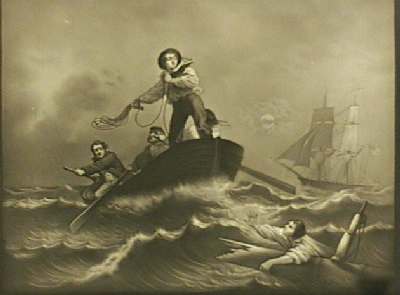
You go out sailing in a small boat on a large body of water. By yourself. You don't wear the life-vest your parents gave you (you're not even sure where it is). But you've taught yourself how to sail a boat and how to swim. You are confident in your abilities, up to a point (you don't intend to go too far out in the small, Sunfish-class sailboat).
But a squall blows in suddenly, pushing you out into the water. You struggle to get your boat back to the protection of the shoreline, but the rising waves, driving rain, and growing darkness make the struggle difficult. You fall overboard. You panic in the cold water, as you see your boat driven away from you. In your panic, you cry out for help, even though you don't think anyone can hear you.
But to your great surprise, a voice calls out. "I can save you!" You look around, and you see a large boat has appeared in the storm. A burly, strong, handsome sailor stands at the rails with a lifeline in his hands. He throws it out into water. "Grab the line, and I'll pull you onboard!"
Response A: In your panicked state, you think the lifeline is a water moccasin. "Get away from me!" you scream, and kick the lifeline away. Thrashing about, fearing there is a serpent in the water near you, you sink beneath the waves.
Response B: You are embarrassed. The expert sailor has seen you foolishly overturn your boat ("The waves weren't really that high, and the wind not really that strong," you tell yourself). You imagine that he and his friends on the boat will laugh at you, behind your back, for needing to be saved. But you are strong, and a good swimmer. "No thanks!" you yell back. "I can swim to the shore. You go find someone who really needs help!" You begin to swim towards where you think the shoreline is, but you swim in the wrong direction. It's dark now, and the large boat is scanning the waves with a searchlight, looking for you. You keep treading water until you are too tired to keep it up any longer. With nothing to hold on to, you slip beneath the waves.
Response C: You reach out weakly and grab the line, which lies at your fingertips. While you hold onto the line, the sailor pulls you to himself, and to safety.
In Response A, did your fear become your undoing? Yes.
In Response B, did your foolish pride become your undoing? Yes. Were you able to save yourself? No.
In Response C, did you save yourself? Of course not. You accepted the saving action of the seaman.
Example Three: (Toastmasters says to always leave them with a joke.)

The rains have been falling up river. The river is rising and will soon crest the banks. The sheriff drives up to your house and warns you to pack your belongings and leave before the flood waters arrive. "I have Faith that the Lord will save me from the flood. I will wait for Him," you respond. The sheriff drives off to warn the next family.
The waters break the levee and flood the county. The water covers the foundation of your house and laps at your front porch. The Red Cross sends a small boat to your door, asking you to leave your house. "I have Faith that the Lord will save me from the flood. I will wait for Him," you tell the Red Cross workers. They leave, looking for others stranded by the rising waters.
The waters rise into your home. You go to the roof. A National Guard helicopter comes by and spots you on the roof. The Guardsmen lower a line to you and tell you to grab hold and they'll pull you to safety. "I have Faith that the Lord will save me from the flood. I will wait for Him," you yell up to the helicopter. They try to argue with you, but you win. They move on in search of others.
The waters continue to rise. You cling to the chimney until the strength of the rushing waters overcome your own strength. You are swept away, under the waters.
You wake up in Heaven. You approach the Gates and see Peter. He welcomes you, and begins the processing work. Finally he asks you if you have any questions. You do. "I had Faith that the Lord would save me from the flood. I waited for Him, but He never came."
As he opens the Gates of Heaven, Peter looks at you and says, "The Lord sent the sheriff, the Red Cross, and the National Guard to save you, but you wouldn't come."
#
Abandon your pride (it is of no value), overcome your fear (it will not protect you), and grab the lifeline (then you will be saved). Come. Respond. Repent. Follow.
Jun 22, 2012
Worth revisiting.

Answered by a Lover of Free Grace
by John Wesley
1. To say, "This man is an Arminian," has the same effect on many hearers, as to say, "This is a mad dog." It puts them into a fright at once: They run away from him with all speed and diligence; and will hardly stop, unless it be to throw a stone at the dreadful and mischievous animal.
2. The more unintelligible the word is, the better it answers the purpose. Those on whom it is fixed know not what to do: Not understanding what it means, they cannot tell what defence to make, or how to clear themselves from the charge. And it is not easy to remove the prejudice which others have imbibed, who know no more of it, than that it is "something very bad," if not "all that is bad!"
3. To clear the meaning, therefore, of this ambiguous term, may be of use to many: To those who so freely pin this name upon others, that they may not say what they do not understand; to those that hear them, that they may be no longer abused by men saying they know not what; and to those upon whom the name is fixed, that they may know how to answer for themselves.
4. It may be necessary to observe, First, that many confound Arminians with Arians. But this is entirely a different thing; the one has no resemblance to the other. An Arian is one who denies the Godhead of Christ; we scarce need say, the supreme, eternal Godhead; because there can be no God but the supreme, eternal God, unless we will make two Gods, a great God and a little one. Now, none have ever more firmly believed, or more strongly asserted, the Godhead of Christ, than many of the (so called) Arminians have done; yea, and do at this day. Arminianism therefore (whatever it be) is totally different from Arianism.
5. The rise of the word was this: JAMES HARMENS, in Latin, Jacobes Arminius, was first one of the Ministers of Amsterdam , and afterwards Professor of Divinity at Leyden . He was educated at Geneva
6. The errors charged upon these (usually termed Arminians) by their opponents, are five: (1.) That they deny original sin; (2.) That they deny justification by faith; (3.) That they deny absolute predestination; (4.) That they deny the grace of God to be irresistible; and, (5.) That they affirm, a believer may fall from grace.
With regard to the two first of these charges, they plead, Not Guilty. They are entirely false. No man that ever lived, not John Calvin himself, ever asserted either original sin, or justification by faith, in more strong, more clear and express terms, than Arminius has done. These two points, therefore, are to be set out of the question: In these both parties agree. In this respect, there is not a hair's breadth difference between Mr. Wesley and Mr. Whitefield.
7. But there is an undeniable difference between the Calvinists and Arminians, with regard to the three other questions. Here they divide; the former believe absolute, the latter only conditional, predestination. The Calvinists hold, (1.) God has absolutely decreed, from all eternity, to save such and such persons, and no others; and that Christ died for these, and none else. The Arminians hold, God has decreed, from all eternity, touching all that have the written word, "He that believeth shall be saved: He that believeth not, shall be condemned:" And in order to this, "Christ died for all, all that were dead in trespasses and sins;" that is, for every child of Adam, since "in Adam all died."
8. The Calvinists hold, Secondly, that the saving grace of God is absolutely irresistible; that no man is any more able to resist it, than to resist the stroke of lightning. The Arminians hold, that although there may be some moments wherein the grace of God acts irresistibly, yet, in general, any man may resist, and that to his eternal ruin, the grace whereby it was the will of God he should have been eternally saved.
9. The Calvinists hold, Thirdly, that a true believer in Christ cannot possibly fall from grace. The Arminians hold, that a true believer may "make shipwreck of faith and a good conscience;" that he may fall, not only foully, but finally, so as to perish for ever.
10. Indeed, the two latter points, irresistible grace and infallible perseverance, are the natural consequence of the former, of the unconditional decree. For if God has eternally and absolutely decreed to save such and such persons, it follows, both that they cannot resist his saving grace, (else they might miss of salvation,) and that they cannot finally fall from that grace which they cannot resist. So that, in effect, the three questions come into one, "Is predestination absolute or conditional?" The Arminians believe, it is conditional; the Calvinists, that it is absolute.
11. Away, then, with all ambiguity! Away with all expressions which only puzzle the cause! Let honest men speak out, and not play with hard words which they do not understand. And how can any man know what Arminius held, who has never read one page of his writings? Let no man bawl against Arminians, till he knows what the term means; and then he will know that Arminians and Calvinists are just upon a level. And Arminians have as much right to be angry at Calvinists, as Calvinists have to be angry at Arminians. John Calvin was a pious, learned, sensible man; and so was James Harmens. Many Calvinists are pious, learned, sensible men; and so are many Arminians. Only the former hold absolute predestination; the latter, conditional.
12. One word more: Is it not the duty of every Arminian Preacher, First, never, in public or in private, to use the word Calvinist as a term of reproach; seeing it is neither better nor worse than calling names? -- a practice no more consistent with good sense or good manners, than it is with Christianity. Secondly. To do all that in him lies to prevent his hearers from doing it, by showing them the sin and folly of it? And is it not equally the duty of every Calvinist Preacher, First, never in public or in private, in preaching or in conversation, to use the word Arminian as a term of reproach? Secondly. To do all that in him lies to prevent his hearers from doing it, by showing them the sin and folly thereof; and that the more earnestly and diligently, if they have been accustomed so to do? perhaps encouraged therein by his own example!
From the Thomas Jackson edition of The Works of John Wesley, 1872.
Jun 21, 2012
The World Turned Upside Down.

If ponies rode men and grass ate cows,
And cats were chased into holes by the mouse . . .
If summer were spring and the other way round,
Then all the world would be upside down.
Jun 17, 2012
His day.

"We must not measure by natural human fatherhood what it means that God is our Father. It is from God's fatherhood that our natural human fatherhood acquires any meaning and dignity it has. God is the Father 'from whom his whole family in heaven and on earth derives its name.'"
-- Karl Barth (1886-1968)
For Harry C. Summer (1918-1996). Thanks, Dad.
Jun 9, 2012
Sighted List

As seen and noted on my morning walks.
- River Cooter Turtle
- Guadalupe Spiny Soft-Shelled Turtle
- Yellow Belly Water Snake
- Eastern Yellow Racer Snake
- Cotton-tailed Rabbit
- Jack Rabbit
- Great Blue Heron
- Crane
- Sandpiper
- Crested Duck
- Mud Hen
- Egret
- Alligator Gar
- Bream
- Coyote (spoor)
- Horned Ow
- Beaver (sign)
- Deer (tracks)
- Raccoon (tracks)
- Purple Martin
- Tilapia
- Barn Swallow
- Scissor-tailed Flycatcher
- Pill Bug
- Oriole
- Sand Piper
- Cow Bird
- Crow
- Cardinal
- Raven
- Red Harvester Ant
- Prickly Pear
- Spanish Moss
- Bois D'Arc
- Cat Tail
- Thistle
- Black-eyed Susan
- Texas Blue Bell
- Mockingbird
- English Sparrow
- Mourning Dove
- White-wing Dove
- Red Peppered Moth
- Dragon Fly
- Gnat
- Mosquito
This list is updated as things stand out.
May 30, 2012
On the road again.

Psalm 119:25
English Standard Version (ESV)
My soul clings to the dust;
give me life according to your word!
give me life according to your word!
May 28, 2012
Hot-Peppered Moth Evolution

The evolution of the peppered moth over the last two hundred years has been studied in detail. Originally, the vast majority of peppered moths had light colouration, which effectively camouflaged them against the light-coloured trees and lichens which they rested upon. However, because of widespread pollution during the Industrial Revolution in England, many of the lichens died out, and the trees that peppered moths rested on became blackened by soot, causing most of the light-coloured moths, or typica, to die off from predation. At the same time, the dark-coloured, or melanic, moths, carbonaria, flourished because of their ability to hide on the darkened trees.-from Wikipedia
May 26, 2012
Take a walk on the wild side.


I grew up in large part along the shore of Lake Texoma on the Red River (literally, a stone throw from Oklahoma). Every day, my mother would walk down to the lake in the cool of the morning. It was about a mile-long trek down a dirt road, with a steep hill down to the lake shore. She'd then walk along the shoreline. It was not a car-friendly road (we had a couple of four-wheel-drive trucks when we were in a hurry), so it was almost always very quiet.
I would often walk with her, observing (and discussing) the flora and fauna as we strolled. That was a long time ago, but they are times I will always cherish.
I live in an exurban community now, where cattle grazed just a few short years ago. It's a planned community. 'Seaside-on-the-Prairie', I call it. There is a small lake nearby (a former gravel pit) with a jogging path around it. I've taken to walking around it in the cool of the mornings. The pictures above are from this morning's walk.
What goes around, comes around.
May 21, 2012
Choose sides.
“Oh, I may be on the side of the angels - but don't think for one second that I am one of them.”
-- Stephan Moffatt, screenwriter, as spoken by his characterization of Sherlock Holmes.
May 13, 2012

May 10, 2012
An opinion piece on the BBC website
Rod Dreher, senior editor of the American Conservative:
I am supposed to be heartened by North Carolina's vote this week against same-sex marriage.
After all, I am a social and religious conservative who lives in a small town in Louisiana, the deepest part of the Deep South. We Southerners have held the line for tradition and moral truth about marriage every time the issue has been put on the ballot here. Given how decisive the North Carolina vote was, and given that gay marriage proponents have lost in every state, even culturally liberal California, it is tempting to think we can stand athwart history yelling, "Stop!" If only. I think ours is a lost cause. And we Southerners know something about lost causes.
When US President Barack Obama
announced on ABC News yesterday that he favours same-sex marriage, a
journalist friend inside a Manhattan newsroom wrote that every one of
his colleagues stood at their desks, staring at the screens "like it was
the moon landing". Of course. It is impossible to overstate the depth and breadth of media support for same-sex marriage. In my newsroom experience, it is taken as given that any opposition to gay marriage can only come from rank bigotry. You would no more take a defender of traditional marriage
seriously than you would take a segregationist seriously - or so the
thinking goes. Trying to explain philosophically why homosexuality is
not the same thing as race draws blank stares. This is simply not something to be reasoned about, especially
not with my generation of journalists: too young to have seen the black
civil rights movement, and who are not about to miss out on their own
version. Though I firmly believe there is only a superficial
connection between gay marriage and inter-racial marriage, the legacy of
the civil rights movement in the South is precisely why I think
marriage traditionalists are going to lose in the long run.
I recently moved back to my hometown, a Louisiana country village of 2,000 people, after living away for nearly 30 years. Though my generation was the first to attend racially integrated schools from the beginning of our education, the relative comity that exists here now between the races - half the town is black, the other half white - is, as you would expect, partly a result of familiarity. Integrating state schools would not have happened if elites (I use the term descriptively, not pejoratively) in the 50s and 60s had not held the federal judiciary and imposed their moral views over popular local will.
That is only part of the story, though, and not the most important part. Yes, I went to school with black children. But despite this it was not as hard as you might think to maintain one's prejudices. Nothing in the local culture actively challenged racist beliefs. Churches avoided controversy by ignoring the issue. So, we Southern children of the 70s and beyond were catechised on the wrongness of racism primarily by television and media culture. It was impossible to watch TV back then and not notice that the conventional racial opinions held by local whites were treated as backward and immoral. They were, in fact, precisely that, but my point here has to do with media ecology. Mass media framed the debate over race in America in a way that stigmatised white racism, and made old-fashioned views obsolete and even embarrassing. The rigid old way of thinking, happily, did not survive a single generation.
In my town we have not achieved a Valhalla of tolerance, but social progress on the race question has been breathtaking. Whatever views people may hold privately, only the most truculent racists - the sort one rarely sees in public life these days - would favour laws and policies that were commonplace here as late as the mid-60s. Racism is seen as trashy - as vulgar - even here in a former segregationist stronghold. This tells us something about the future of gay marriage, given the dominance of the "civil rights" narrative in the public square. As is commonly known, polling data show a stark generational divide among Americans on same-sex marriage. The younger the voter, the greater the support. The demographic tidal wave on this issue is undeniable.
Gay marriage opponents like to tell themselves that people get more conservative as they age - true, in general, but unlikely in this case. As long as the traditionalist position on same-sex marriage, almost universally held only 25 years ago, is treated as irrational hatred and nothing but by the media, business, and social elites, there will be powerful social and psychological pressure to shun it. American business culture is increasingly pro-gay. If the US Supreme Court constitutionalises same-sex marriage the cultural, legal and financial pressure (through the tax code) against conservative churches to abandon orthodox Christian teaching will be enormous.
Leaving aside the role of elites in forming mass opinion, it is not sufficiently appreciated why so many younger Americans support same-sex marriage. It fits easily with what they already believe about the nature of marriage, of sex, of liberty, and of human nature. The high level of religiosity shown in US polls is deceiving. More recent, comprehensive research by political scientists Robert Putnam and David Campbell, and sociologist Christian Smith, indicates that young Americans are not only abandoning formal religious observance in large numbers (while still claiming to be "spiritual"), but they see religion primarily in therapeutic terms. That is, they believe that God wants us to be nice, happy and self-fulfilled - and that's about it. As the late sociologist Philip Rieff observed in his great 60s work of cultural analysis, The Triumph of the Therapeutic, Western culture had by then abandoned the Christian moral matrix, especially on sexual matters.
Given the haplessness of the churches as a counter-cultural force to the hedonism and individualism celebrated by popular culture, it should surprise no-one that arguments, Christian and otherwise, for traditional marriage are hard for young people to conceptualise. Traditionalists keep winning battles, but we have lost the war at the level of ideas. Our moral and religious claims strike many as illiberal (therefore incorrect) and sociological contentions about the integral importance of traditional family structure to society's health are cold-hearted abstractions. The collapse of Christianity's cultural authority has been profound. Prejudice - either in the bad sense of mindless bigotry, or the good, Burkean sense - is the only thing keeping gay marriage at bay. This will not last, especially as the social, legal, and commercial price for holding fast to tradition increases, as it certainly will, now that same-sex marriage commands the high ground in the US social and cultural hierarchy.
Gay marriage completes the institutionalisation of the sexual revolution, against which the forces of social conservatism and religious tradition have been impotent. As pleasing as ballot box victories are, I see no reason for the long defeat to reverse, at least not in my lifetime. Like it or not, this is what it means to live after the passing of the Christian era.
Email: rod.dreher@gmail.com
From the BBC.
I am supposed to be heartened by North Carolina's vote this week against same-sex marriage.
After all, I am a social and religious conservative who lives in a small town in Louisiana, the deepest part of the Deep South. We Southerners have held the line for tradition and moral truth about marriage every time the issue has been put on the ballot here. Given how decisive the North Carolina vote was, and given that gay marriage proponents have lost in every state, even culturally liberal California, it is tempting to think we can stand athwart history yelling, "Stop!" If only. I think ours is a lost cause. And we Southerners know something about lost causes.
I recently moved back to my hometown, a Louisiana country village of 2,000 people, after living away for nearly 30 years. Though my generation was the first to attend racially integrated schools from the beginning of our education, the relative comity that exists here now between the races - half the town is black, the other half white - is, as you would expect, partly a result of familiarity. Integrating state schools would not have happened if elites (I use the term descriptively, not pejoratively) in the 50s and 60s had not held the federal judiciary and imposed their moral views over popular local will.
That is only part of the story, though, and not the most important part. Yes, I went to school with black children. But despite this it was not as hard as you might think to maintain one's prejudices. Nothing in the local culture actively challenged racist beliefs. Churches avoided controversy by ignoring the issue. So, we Southern children of the 70s and beyond were catechised on the wrongness of racism primarily by television and media culture. It was impossible to watch TV back then and not notice that the conventional racial opinions held by local whites were treated as backward and immoral. They were, in fact, precisely that, but my point here has to do with media ecology. Mass media framed the debate over race in America in a way that stigmatised white racism, and made old-fashioned views obsolete and even embarrassing. The rigid old way of thinking, happily, did not survive a single generation.
In my town we have not achieved a Valhalla of tolerance, but social progress on the race question has been breathtaking. Whatever views people may hold privately, only the most truculent racists - the sort one rarely sees in public life these days - would favour laws and policies that were commonplace here as late as the mid-60s. Racism is seen as trashy - as vulgar - even here in a former segregationist stronghold. This tells us something about the future of gay marriage, given the dominance of the "civil rights" narrative in the public square. As is commonly known, polling data show a stark generational divide among Americans on same-sex marriage. The younger the voter, the greater the support. The demographic tidal wave on this issue is undeniable.
Gay marriage opponents like to tell themselves that people get more conservative as they age - true, in general, but unlikely in this case. As long as the traditionalist position on same-sex marriage, almost universally held only 25 years ago, is treated as irrational hatred and nothing but by the media, business, and social elites, there will be powerful social and psychological pressure to shun it. American business culture is increasingly pro-gay. If the US Supreme Court constitutionalises same-sex marriage the cultural, legal and financial pressure (through the tax code) against conservative churches to abandon orthodox Christian teaching will be enormous.
Leaving aside the role of elites in forming mass opinion, it is not sufficiently appreciated why so many younger Americans support same-sex marriage. It fits easily with what they already believe about the nature of marriage, of sex, of liberty, and of human nature. The high level of religiosity shown in US polls is deceiving. More recent, comprehensive research by political scientists Robert Putnam and David Campbell, and sociologist Christian Smith, indicates that young Americans are not only abandoning formal religious observance in large numbers (while still claiming to be "spiritual"), but they see religion primarily in therapeutic terms. That is, they believe that God wants us to be nice, happy and self-fulfilled - and that's about it. As the late sociologist Philip Rieff observed in his great 60s work of cultural analysis, The Triumph of the Therapeutic, Western culture had by then abandoned the Christian moral matrix, especially on sexual matters.
Given the haplessness of the churches as a counter-cultural force to the hedonism and individualism celebrated by popular culture, it should surprise no-one that arguments, Christian and otherwise, for traditional marriage are hard for young people to conceptualise. Traditionalists keep winning battles, but we have lost the war at the level of ideas. Our moral and religious claims strike many as illiberal (therefore incorrect) and sociological contentions about the integral importance of traditional family structure to society's health are cold-hearted abstractions. The collapse of Christianity's cultural authority has been profound. Prejudice - either in the bad sense of mindless bigotry, or the good, Burkean sense - is the only thing keeping gay marriage at bay. This will not last, especially as the social, legal, and commercial price for holding fast to tradition increases, as it certainly will, now that same-sex marriage commands the high ground in the US social and cultural hierarchy.
Gay marriage completes the institutionalisation of the sexual revolution, against which the forces of social conservatism and religious tradition have been impotent. As pleasing as ballot box victories are, I see no reason for the long defeat to reverse, at least not in my lifetime. Like it or not, this is what it means to live after the passing of the Christian era.
Email: rod.dreher@gmail.com
From the BBC.
Apr 8, 2012
Me too.

Found photograph
Put On the New Self
Put on then, as God's chosen ones, holy and beloved, compassionate hearts, kindness, humility, meekness, and patience, bearing with one another and, if one has a complaint against another, forgiving each other; as the Lord has forgiven you, so you also must forgive. And above all these put on love, which binds everything together in perfect harmony. And let the peace of Christ rule in your hearts, to which indeed you were called in one body. And be thankful. Let the word of Christ dwell in you richly, teaching and admonishing one another in all wisdom, singing psalms and hymns and spiritual songs, with thankfulness in your hearts to God. And whatever you do, in word or deed, do everything in the name of the Lord Jesus, giving thanks to God the Father through him.
Colossians 3:1-17
English Standard Version (ESV)

Apr 7, 2012
It is done.

Unattributed on the web.
Suspended between Earth and Heaven... descended to the place of the dead.
Apr 6, 2012
The Revelation to John

P.M. Summer, 2012
"Don't fear: I am First, I am Last, I'm Alive. I died, but I came to life, and my life is now forever. See these keys in my hand? They open and lock Death's doors, they open and lock Hell's gates."
Revelation 1:17-18, The Message

That's me on the far right.

Ecce Homo
Andrew Hudgins
Christ bends, protects his groin. Thorns gouge his forehead, and his legs are stippled with dried blood. The part of us that's Pilate says, Behold the man. We glare at that bound, lashed, and bloody part of us that's Christ. We laugh, we howl, we shout. Give us Barabbas, not knowing who Barabbas is, not caring. A thief? We'll take him anyway. A drunk? A murderer? Who cares? It's better him than this pale ravaged thing, this god. Bosch knows. His humans waver, laugh, then change to demons as if they're seized by epilepsy. It spreads from eye to eye, from laugh to laugh until, incited by the ease of going mad, they go. How easy evil is! Dark voices sing, You can be evil or you can be good, but good is dull, my darling, good is dull. And we're convinced: How lovely evil is! How lovely hell must be! Give us Barabbas!
Lord Pilate clears his throat and tries again: I find no fault in this just man. It's more than we can bear. In gothic script our answer floats above our upturned eyes. O crucify, we sing. O crucify him!
Subscribe to:
Posts (Atom)